Document owner
Gabriella Prandini, Managing Director, Loop
Date of publication
June 2025
Date of next review
July 2026, or sooner if Loop enters a new country or legal context in any of the current countries changes
This Framework is a live document which is continuously improved and clarified as we learn and grow on an ongoing basis and at least annually. We invite your feedback and suggestions to help us on the journey of keeping people safe and helping them get the assistance and accountability they require. To provide feedback, please email Camille at camille@talktoloop.org .
This document outlines the referral framework that Talk to Loop uses for all sensitive feedback. This document describes the fundamental principles of the Loop Standard Operating Procedures (SOPs) for handling sensitive feedback.
The document additionally explains the way in which Talk to Loop’s SOPs are contextualised in different organisation’s geographies; including integrating and supporting the operationalisation of United Nations (UN), Government and partner SOPs and referral pathways.
Table of contents:
Framing
Reporting to Loop
Informed Consent and Assent
Loop Procedures
Referrals for Assistance and Services
Allegation referrals
Closing the Feedback Loop
Training and Supervision
Key Concepts and Guiding Principles
Do No Harm
Confidentiality
Informed consent
Informed assent
Survivor-centred approach
Best interests of the child
Mandatory reporting
Protection
Mental Health and Psychosocial Support
Child Protection
Gender-Based Violence
Corruption, Fraud and Other Misconduct
Sexual Exploitation, Abuse and Harassment (SEAH)
Other Complaints tagged sensitive by the author
Loop is a general feedback mechanism that additionally has the capacity to handle sensitive feedback. Sensitive feedback is any information that can put the person sharing it or other people linked to it at risk and needs to be handled with care. Sensitive feedback includes complaints as well as reports of protection violations. The framing of Loop as a general feedback mechanism provides a non-stigmatising means for those affected by sensitive situations to gain information and access referrals to appropriate specialised services and to make complaints safely.
Loop does not do case management or investigations. Instead, Loop refers on cases to relevant qualified actors for assistance including for case management or to implicated organisations for investigation, following the principles and procedures described in detail below.
At the global level, Loop has Sensitive Feedback Leads trained to handle sensitive feedback, which includes the following types of feedback, defined in more detail below:
The Loop Sensitive Feedback team is trained based on global standards including CHS Alliance, Interagency GBV Case Management Guidelines, Interagency Guidelines for Case Management and Child Protection, and IASC-IOM PSEA Coordinator training.
Sensitive feedback can be reported by anyone, at any time. Anyone who uses Loop to report feedback is considered an author, and referred to throughout this document using the term ‘author’. The safest way to report sensitive feedback is through the Loop website as it meets the highest standards of data protection and privacy. For more information about data protection and privacy, please see Loop’s Data Protection Impact Assessment: DPIA.
It is important to note that Loop does not actively seek out GBV reports, but is designed in such a way that it is equipped to handle reports in the safest way possible. Loop has been designed for safety, privacy and security, and accessibility, and acceptability, taking into account considerations laid out in the GBV AOR’s Briefing Note on Prioritizing Safety and Support in Digital Reporting of Gender-Based Violence.
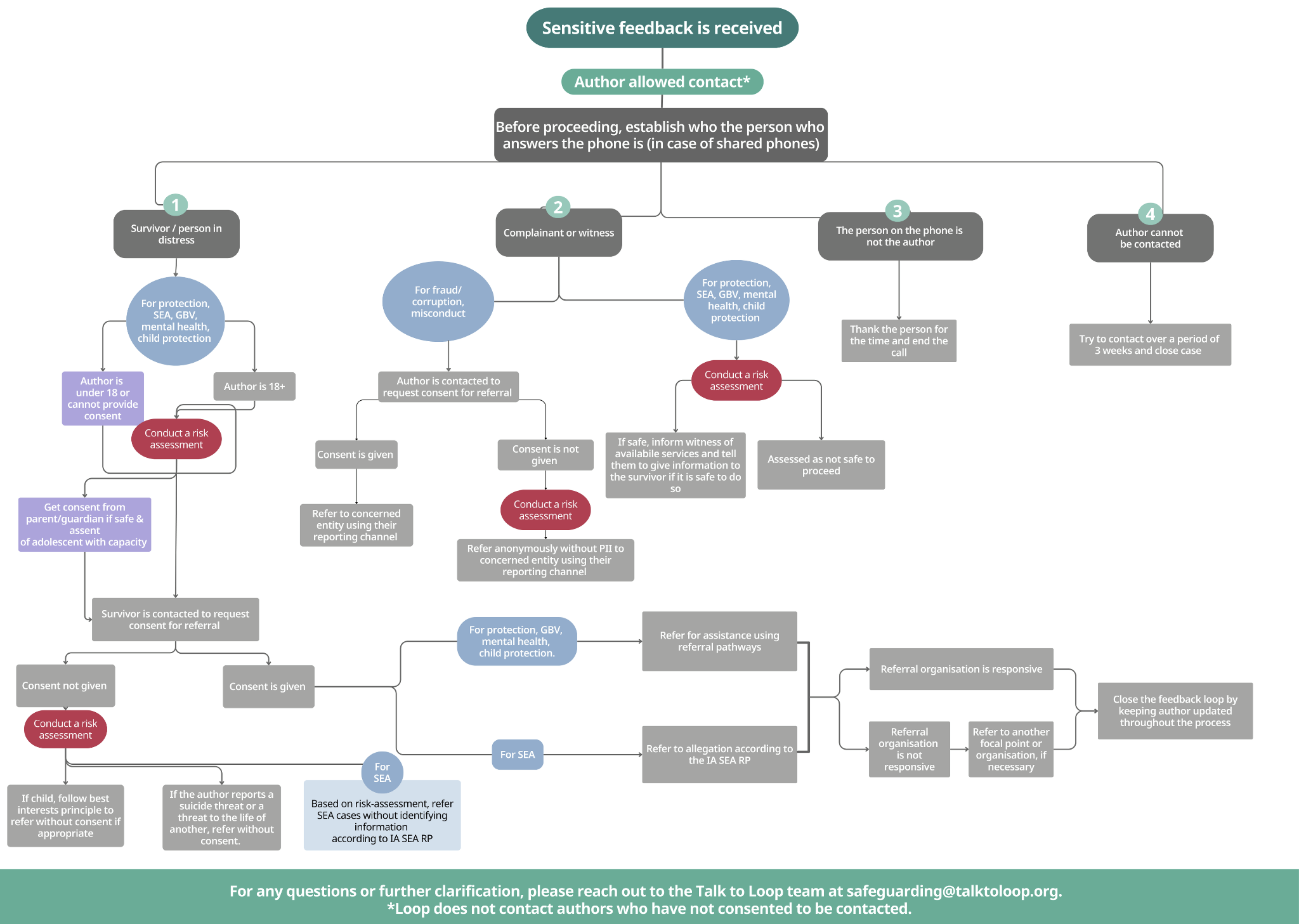
Loop strives to process all urgent feedback in the shortest possible time, and no longer than 48 hours. Urgent feedback is defined as any feedback that requires an urgent response, including all feedback requiring an urgent medical response such as the administration of a PEP-kit, addressing life-threatening injuries as well as threats to life such as suicidal ideation or threats to others’ life. When sensitive feedback is reported and the author of the feedback gives consent to be contacted by Loop, a trained Loop moderator (the Country Sensitive Feedback Lead), who speaks the author’s language will contact the author and carefully determine whether the author of the feedback is the survivor, a witness, or another person.
For example, in the scenario where people are sharing phones they may have no knowledge of the report. Loop moderators never disclose information about the feedback content or author of the feedback without first verifying who they are speaking with.
Loop requires two levels of consent for sensitive feedback, one at the time of submission of feedback for Loop to contact the author and a second level of consent is requested at the time of referral for each individual referral. For authors reporting fraud and corruption allegations who do not give consent to share their name and contact information for onward referral, Loop will conduct a risk assessment and try to share the feedback to a relevant organisation for investigation without sharing any personally identifiable information (PII), unless it is the wish of the complainant that no anonymous referral be made.
For all protection reports (including child protection, GBV, SEA, etc.) Loop requires informed consent before proceeding with any referral, in line with the survivor-centred approach.
For protection reports, if the reporter is not the survivor but the witness, Loop will not proceed with any referral except under specific circumstances. Instead, Loop will conduct a risk assessment and try to advise the witness on available services in the area in case there is a safe way to pass this information on to the survivor.
If the survivor is a child or has reported harm to themselves or others, a risk assessment will be conducted before deciding whether to proceed with a referral without consent. More details on each type of feedback can be found below.
For all sensitive feedback that requires a referral for assistance, such as protection, mental health and psycho-social support, child protection, or GBV, Loop follows interagency referral procedures and, where applicable, a survivor-centred approach. In regions where there are no referral pathways or services, Loop follows the guidance for how to support survivors laid out in the GBV Pocket Guide.
Urgent cases are referred on as quickly as possible, but unfortunately sometimes it is difficult to get in touch with authors to obtain their consent and process the referral. In the scenario where the referral organisation is not responsive, Loop will identify another referral organisation using existing referral pathways. In humanitarian contexts, Loop participates in clusters and working groups and signs onto interagency SOPs.
Loop actively maintains and updates referral pathways to ensure that the latest information is available in case of emergencies. Referral pathways are also updated and informed by feedback from survivors who have received services.
For all sensitive feedback that requires a referral for a potential investigation (SEA, fraud and corruption, other misconduct, non-sensitive feedback that has been tagged sensitive by the author), Loop will refer the details of the feedback to the concerned entity (the organisation that has been implicated in the feedback), after conducting a risk assessment and obtaining informed consent. Contact details will also be shared if consent was given by the author, otherwise the report can be referred anonymously. For SEA allegation referrals, Loop refers to the Interagency Sexual Exploitation and Abuse Referral Procedures (IA SEA RP) in countries where they are being implemented. In specific circumstances, this means that the allegation referral may go through another party and not directly to the concerned entity.
For reports of fraud and corruption where consent is not obtained, Loop will only refer non-identifiable details of the feedback to the organisation for their follow up, upon determining it is safe to do so through a risk assessment. In reports of sexual misconduct, the survivor-centred approach necessitates that Loop conducts a risk assessment before referring to anonymous reports. This sometimes does mean an investigation cannot be opened because there is not enough information. Loop tries, to the best of its ability, to follow up with authors in these cases to obtain the necessary details but it is not always possible. In some situations, authors may feel more comfortable providing information to Loop rather than to the organisation and this will be accommodated and shared with consent where possible.
In the scenario where the organisation does not respond within 48 hours, Loop will continue to try to reach out for an additional five days, at various hours. Survivors who require urgent assistance will be referred for services separately, if they consent.
After a week if there is still no acknowledgement of an allegation referral, Loop will escalate the feedback internally within the organisation implicated. For example we will inquire about an alternative focal point, referring to another internal reporting channel, or to a regional or HQ-level focal point within the organisation.
If the organisation continues to not be responsive after following up with various contacts to find the appropriate referral point or mechanism and there has been no confirmation of receipt, Loop may contact another relevant organisation that could respond to the feedback with consent from the author. For example, an interagency referral mechanism, a donor or a relevant cluster. In these cases, some information may need to be removed to protect confidentiality, making it difficult to conduct an investigation. In many cases, the feedback is still useful for the purposes of identifying gaps in services, trends in geographical areas and for M&E purposes.
In the scenario where the organisation is not named or known by the author, Loop will try to refer the feedback to another actor responsible to help the author and where SOPs are in place to accept such feedback. This information may be useful to track trends and inform programmatic and sector-level decision-making at the aggregate level. Such stakeholders are country and context specific and may include the PSEA Network or relevant body, such as designated reporting channels including the HC/RC office, relevant clusters, office of an ombudsman or anti-corruption organisation, among others.
Loop requests all actors that receive referrals from Loop, at a minimum, to acknowledge receipt of the referral, as per global accountability standards.
IASC Best Practice Guide for Inter-Agency Community-Based Complaint Mechanisms.
In order to better understand and analyse the state of accountability systems and track trends and gaps, Loop requests that organisations receiving referrals report back to Loop on key milestones, including: acknowledgement of receipt and processing, decision to investigate or not, and decision to close a case.
CHS Alliance, Guidelines for Investigations; ICVA, Building Safer Organisations; Special measures for protection from sexual exploitation and sexual abuse : report of the Secretary-General, para 50 & 51
Loop strives to close the feedback loop to ensure that authors of all feedback, including sensitive feedback, are able to understand the status of their cases and give additional feedback on the process. However, Loop is dependent on other actors to close the feedback loop with authors who report to Loop. Loop uses this data to maintain aggregate anonymised statistics which help to understand where gaps in accountability systems are.
Where possible, Loop collects feedback from authors who have been referred on to other actors for services, so as to understand their experience and take it into consideration for future referrals.
Loop Sensitive Feedback Leads sit within the global Loop team and are responsible for overseeing the handling of all sensitive feedback at the country-level as well as providing ongoing individual and group supervision to moderators. All Loop staff are trained in safeguarding on a bi-annual basis.
Loop Sensitive Feedback Leads are trained in Managing Investigations, SEA coordination and GBV and Child Protection case management. Supervision is provided to moderators following Interagency GBV case management standards.
The Loop Sensitive Feedback team is trained based on global standards including CHS Alliance, Interagency GBV Case Management Guidelines, Interagency Guidelines for Case Management and Child Protection, and IASC-IOM PSEA Coordinator training.
The rest of this Framework defines the key concepts that Loop uses and how we manage specific types of Sensitive Feedback. This is useful for a deeper understanding of the statistics page analytics as well as our specific referral mechanisms for different types of sensitive feedback.
Each piece of feedback is managed based on its individual circumstances and needs. Each country is different, the risks vary, the mapping and depth of engagement varies, other actors may or may not be present and so Loop must be flexible and adaptive. We follow the below guiding concepts in our decision making and we align as much as possible with sector wide best practice, definitions and guiding principles.
As these change and improve, Loop will aim to align and update this document and our approaches as well as data tagging. Feedback is always welcome to help us on this journey.
The principle of 'do no harm' obliges individuals and organisations working in humanitarian and development contexts to prevent and mitigate any negative impact of actions taken in the course of carrying out aid work. In carrying out their functions, the Loop Sensitive Feedback Leads are always mindful that any decisions and/or actions taken by them should not cause any further harm to the author or survivor of a sensitive feedback post.
Confidentiality covers the identity of those who have provided the information, as well as the information itself. Victims/survivors have the right to choose to whom they will or will not tell their story, however, victims/survivors must be informed of the limits of confidentiality, including informing them when mandatory reporting procedures are in place and what these imply. Outline the information that may be transmitted, to whom, and for what purpose, as early as possible and before the victim/survivor shares their personally identifiable information and incident details. Explain any implications on the scope and conduct of a possible investigation of a victim’s/survivor’s choice to keep information confidential. Ensure that robust data protection measures are in place. All information contained in a complaint, or a report, must remain confidential and information is shared with the minimum number of people necessary, strictly on a need-to-know basis, for the purpose of referral and service provision, based on the informed consent of the victim/survivor. (IASC Guidance: Inter-Agency SEA Referral Procedures).
Any personal information that an individual discloses in sensitive feedback is considered confidential. This means that there is an implicit understanding that identifying information in the sensitive feedback post will not be shared with others, unless the author (and, where relevant, the survivor) gives explicit and informed consent to do so.
For cases involving children or where a person is presenting as a threat to themselves or others, there may be limits to confidentiality. These are explained to the author and, where relevant, the survivor. In these cases, information is shared on a need-to-know basis and with as few people as necessary.
Consent is based upon the victim’s/ survivor’s clear appreciation and understanding of the facts, implications and potential consequences of an action. Actively seek consent from victims/survivors on the possible use of the information they provide. Endeavor to make no information disclosure at any time to any party without the informed consent of the victim/ survivor. Inform victims/survivors about their right to engage or not to engage in a process and the fact that the IASC entity may decide to pursue management action,42 without their consent and participation, to prevent further harm (see mandatory reporting below). A victim/survivor can withdraw their consent to participate in the process at any time, without impacting their right to assistance. In cases involving young children where informed consent is not possible, their informed assent may be sought in a manner consistent with their evolving capacity. (IASC Guidance: Inter-Agency SEA Referral Procedures).
The role of informed consent is to ensure that all authors of feedback using the Loop platform are aware of, and understand, how information will be shared with others during the referral process. This includes how data will be stored, and also their rights (WHO Ethical and Safety Recommendations for Researching, Documenting and Monitoring Sexual Violence in Emergencies).
Loop contacts authors and discusses with them about options of where to refer their report to, who the referral agency is, and discusses the author’s options and to what they consent to share with whom. The authors decide on their preferred course of action. All authors of sensitive feedback give consent about whether identifying information will be shared, and if so, how and with whom. If identifiable information is going to be shared with third parties, the identity of these third parties will be disclosed to the author, as per the WHO recommendations.
Informed assent is the expressed willingness of the child to participate in services. For younger children who are by definition legally too young to give informed consent, but developmentally old enough to understand and agree to participate in services, the child’s “informed assent” is sought.
The survivor-centred approach applies in cases where there is a survivor of gender-based violence ('GBV'), SEAH or other violence. The term ‘survivor’ is used by Loop due to the empowering framing of the work, given that perpetrators of violence abuse power differentials. Using a survivor-centred approach means that the survivor’s rights, needs and wishes are prioritised when coordinating, and referring on, in accordance with the guiding principles (Handbook for Coordinating GBV in Emergencies). The key elements of the survivor-centred approach build on the guiding principles of safety, confidentiality, respect and non-discrimination.
The best interests of the child guide all sensitive feedback concerning children (18 years and under). In implementing this principle, the best interests of the child shall be the primary consideration in all actions concerning children (Minimum Standards for Child Protection in Humanitarian Action).
Mandatory reporting refers to an obligation to report SEA perpetrated by UN staff or related personnel, non-UN forces operating under a Security Council mandate, and implementing partner staff and related personnel in line with established reporting procedures. Compliance with mandatory reporting of SEA complaints is a requisite for all UN entities, their partners, and IASC member entities; reporting obligations exist whether or not the alleged perpetrator is from the same entity. All IASC member organisations are mandated to have protocols for responding to SEA. Victims/survivors must be informed of entities’ mandatory reporting obligations as soon as they come forward with a complaint. Victims/survivors should also be informed of their rights related to informed consent and its implications; confidentiality protections; and that assistance is offered to victims/survivors irrespective of whether they initiate or cooperate with an investigation or other accountability procedure (IASC Guidance: Inter-Agency SEA Referral Procedures).
This is not to be confused with national laws and policies which require mandatory reporting from service providers to report to police or other government authorities any acts that are believed to be criminal offences. Loop maintains an analysis of national mandatory reporting guidelines in the countries where it is present.
Protection cases are defined as cases where basic human rights have been violated. Human rights are enshrined by the Universal Declaration of Human Rights and other related instruments and include economic and social rights as well as land rights (Office of the High Commissioner for Human Rights).
Loop refers individual protection cases according to global standards and best practice including UNHCR’s Your Guide to Protection Case Management.
The term mental health and psychosocial support is used to describe any type of local or outside support that aims to protect or promote psychosocial well-being and/or prevent or treat mental disorder (IASC Guideline: Mental Health and Psychosocial Support in Emergency Settings).
Loop refers mental health cases following global standards, including the IASC 2022 MHPSS Minimum Service Package.
Child protection violations are an act of violence, exploitation or abuse against a child, including neglect (UNICEF). For the purposes of international best practice, a child is considered any person under the age of 18 (Convention on the Rights of the Child), irrespective of laws and/or customary practices in individual countries (ST/SGB/2003/13).
Loop does not actively promote children under the age of 14 to use Loop reporting channels although Loop recognizes that this does happen. Other responsible adults may report on behalf of a child e.g., a parent, guardian or a teacher.
https://pediatrics.jmir.org/2021/2/e22281/
https://www.unicef.dk/wp-content/uploads/2022/09/industry-toolkit-children-digital-marketing_07.pdf
Loop relies on self-reporting to understand the age of authors on the platform and this cannot be verified. If the author states that they are an adolescent between the ages of 14 and 18 then Loop will work with the adolescent and try to involve a safe and trusted adult to obtain informed consent and assent, according to the adolescents’ evolving capacity after determining whether it is safe to do so through a risk assessment.
If the young person states that they are younger than 14 then Loop will automatically treat the feedback as sensitive and ensure that it is not published on the public platform. Loop will try to involve a safe and trusted adult to support the child through the process. Children who have been emancipated from their parents or guardians will be treated as adults.
Loop refers child protection cases following global standards and best practice, including The Interagency Guidelines for Case Management and Child Protection.
Gender-based violence (GBV) is an umbrella term for violence directed toward or disproportionately affecting someone because of their actual or perceived gender identity. The term ‘gender-based violence’ is primarily used to underscore the fact that structural, gender-based power differentials around the world place women and girls at risk for multiple forms of violence. This includes acts that inflict physical, sexual or mental harm or suffering, threats of such acts, coercion, and other deprivations of liberty, whether occurring in public or in private life.
While women and girls suffer disproportionately from GBV, men and boys can also be targeted. The term is also used by some actors to describe targeted violence against lesbian, gay, bisexual, transgender, queer and intersex (LGBTQI+ population - UN Glossary on Sexual Exploitation and Abuse).
Loops refers gender-based violence (GBV) cases following global standards and best practice, including the Interagency Gender-Based Violence Case Management Guidelines and GBV AoR’s Briefing Note on Prioritizing Safety and Support in Digital Reporting of GBV.
Reports of corruption and fraud are handled in similar ways, refering them on to relevant actors to assess the possibility to open an investigatation as per their organisational policies. We use UN definitions for there terms:
Corruption is any act of omission that misuses official authority, or seeks to influence the misuse of official authority, in order to obtain an undue benefit for oneself or a third party. The elements of corruption are:
(United Nations Leadership Dialogue 2016)
Fraud is any act or omission whereby an individual knowingly misrepresents or conceals a material fact in order to obtain an undue benefit for oneself or a third party, or to cause another to act to his or her detriment.
The elements of fraud are:
obtain an undue benefit or advantage for himself/herself or a third party or
cause another person to act to his/her detriment
(United Nations Leadership Dialogue 2016)
Loop refers corruption allegations, including fraud, through the organisations’ internal reporting channels for their assessment and decision on whether to open an investigation. Corruption may be channelled to the official complaints reporting channel if one exists, or to the leadership team.
For feedback where the organisation is unknown or where the allegation is against an unknown person, Loop will refer non-identifying information to coordination bodies or to anti-corruption bodies which might be able to use the information to inform context analysis, sector-level or geographical gaps and trends. Where possible, Loop may refer to actors who may be able to do local monitoring visits and use the information for triangulation.
Other forms of misconduct are any act by a staff member that is in contravention of the Code of Conduct that has been signed by the staff member of a particular organisation. Loop considers this an organisational HR issue and refers this feedback to the organisation to be addressed by their internal systems and procedures. If no Code of Conduct has been signed, misconduct may be a breach of humanitarian principles, or a conflict of interest between the staff member and the organisation's interests, engaging in unethical practices, placing staff and/or beneficiaries' safety at risk, and general unprofessionalism. In some scenarios, where there are no internal procedures or Code of Conduct in place, Loop may support the organisation to identify appropriate external investigators and by sharing information about other resources available to them, where appropriate.
Loop refers misconduct allegations through the organisations’ internal reporting channels for their assessment and decision on whether to open an investigation. Misconduct allegations are often channelled to Human Resources departments through the leadership or sensitive reporting channels.
Sexual Exploitation is the actual or attempted abuse of a position of vulnerability, differential power, or trust, for sexual purposes, including, but not limited to, profiting monetarily, socially or politically from the sexual exploitation of another. (Secretary General's Bulletin on Special Measures for Protection from Sexual Exploitation and Sexual Abuse (ST/SGB/2003/13)).
Sexual Abuse is the actual or threatened physical intrusion of a sexual nature, whether by force or under unequal or coercive conditions. Sexual activity with children (persons under the age of 18) is considered sexual abuse regardless of the age of majority or age of consent locally. (Secretary General's Bulletin: Special Measures for Protection from Sexual Exploitation and Sexual Abuse (Secretary General's Bulletin on Special Measures for Protection from Sexual Exploitation and Sexual Abuse (ST/SGB/2003/13)).
At Loop we take the age of the person as reported by the author and are not involved in age verification.
Sexual harassment is any unwelcome conduct of a sexual nature that might reasonably be expected, or be perceived to cause offence or humiliation, when such conduct interferes with work, is made a condition of employment or creates an intimidating, hostile or offensive work environment. Sexual harassment may occur in the workplace or in connection with work. While typically involving a pattern of conduct, sexual harassment may take the form of a single incident. In assessing the reasonableness of expectations or perceptions, the perspective of the person who is the target of the conduct shall be considered. Sexual harassment is the manifestation of a culture of discrimination and privilege based on unequal gender relations and other power dynamics. Sexual harassment may involve any conduct of a verbal, nonverbal or physical nature, including written and electronic communications. Sexual harassment may occur between persons of the same or different genders, and individuals of any gender can be either the targets or the perpetrators. Sexual harassment may occur outside the workplace and outside working hours, including during official travel or social functions related to work. Sexual harassment may be perpetrated by any colleague, including a supervisor, peer or a subordinate. (Secretary-General’s bulletin Addressing discrimination, harassment, including sexual harassment, and abuse of authority (Secretary-General’s bulletin: Addressing discrimination, harassment, including sexual harassment, and abuse of authority (ST/SGB/2019/8))
Loop also acknowledges that sexual harassment is a continuum of unacceptable and unwelcome behaviours and practices of a sexual nature that may include, but are not limited to, sexual suggestions or demands, requests for sexual favours and sexual, verbal or physical conduct or gestures, that are or might reasonably be perceived as offensive or humiliating. Sexual harassment has widely been understood to relate to the workplace, but is also included in the spectrum of behaviours that are not acceptable conduct by our staff, be it in the workplace or with affected populations. (CHS Alliance: PSEAH Implementation Quick Reference Handbook)
Loop follows the Interagency Sexual Exploitation and Abuse Referral Procedures to refer reports of SEA. For feedback where the organisation is not named or known, Loop will refer to the PSEA Network in-country, where available, following the country-specific Interagency CBCM standards and protocols. For urgent cases, Loop refers victims/survivors directly for assistance using the relevant referral pathways (such as GBV or child protection).
For reports of sexual harassment, Loop refers through the organisation’s internal reporting channels.
It may happen that an author tags feedback as sensitive where according to Loop’s definitions and SOPs, it is not. In these circumstances, Loop respects the choice of the author and treats the feedback as sensitive and will not publish it on the Loop open platform. In some cases, these are individual complaints that can be handled by organisations and in other cases, Loop might reach out to authors to understand how to best support.