
Last updated: August 2025
Table of contents:
Loop Complaints, Grievance and Whistleblowing Policy
Types of Complaint
1. Safeguarding Complaints (covered in the Safeguarding Policy)
2. Whistleblowing
3. Grievance
4. Other (General Complaints)
Loop Whistleblowing Policy and Procedure
Policy details
Confidentiality and Anonymity
1. Open reporting
2. Confidential reporting
3. Anonymous reporting
Whistleblowing to an External Body
Involving the press/media
Whistleblowing Procedure
1. Raise your concerns with the Managing Director
2. You will be invited to a meeting at which you can discuss your concerns
3. We will investigate the matters raised
4. We will write to you within 10 working days of receiving your complaint, setting out:
5. We will keep you informed about the progress of the investigation as far as we are able.
6. Appeal
Grievance Procedure
Dealing with grievances informally
Grievance hearing
Appeal
Monitoring and review
Other (General Complaints)
The purpose of the Talk to Loop’s Complaints, Grievance and Whistleblowing Policy is to ensure that we operate with the highest standards of ethical behaviour and transparency by valuing and acting on feedback from all stakeholders. This policy provides clear guidelines and processes for making and handling complaints, ensuring that they are addressed in a fair, appropriate, and timely manner. We encourage open communication and transparency, inviting team members, service users, and other stakeholders to voice their concerns through various channels, promoting continuous improvement and accountability within our organisation.
At Loop, we are committed to operating with the highest standards of inclusion, security, integrity, and quality in everything we do. We value feedback from everyone, recognizing that it may not always be positive. After all, Loop thrives on feedback!
To ensure that we address concerns effectively, we provide multiple channels for team members, service users, and other stakeholders to raise issues they are unhappy with. This Complaints, Grievance, and Whistleblowing Policy defines the types of complaints that can be raised and the procedures for addressing them. We are committed to handling all complaints in a manner that is fair, timely, and appropriate.
For internal complaints, we encourage you to first discuss the matter with your manager in an attempt to resolve the issue informally. If you are unable to speak to your manager, you may consider discussing the matter with another manager. If informal resolution is not possible, please refer to the procedures outlined below.
A safeguarding complaint reports a breach of the Loop Safeguarding Policy and Standards outlined in Loop’s Codes of Conduct, where someone has been harmed or abused, is at risk of harm or abuse or there is a suspicion that harm or abuse has taken place, whether by Loop’s staff, contractors, or partners’ personnel.
If your complaint relates to safeguarding, please refer to the Safeguarding policy for guidance on the appropriate steps to take, as well as Loop’s Safeguarding Procedures.
This complaint is appropriate if you have reason to believe that something dangerous, unlawful or unethical is going on at Loop and have been unable to resolve it with your manager.
If you have a complaint related to your work or colleagues, particularly if it involves a team member violating the Code of Conduct, this is considered a grievance.
Complaints about our platform, service or interactions with external services.
The below flow charts describe our overall Policy for Complaints Management at a global scale and in Somalia and Somaliland
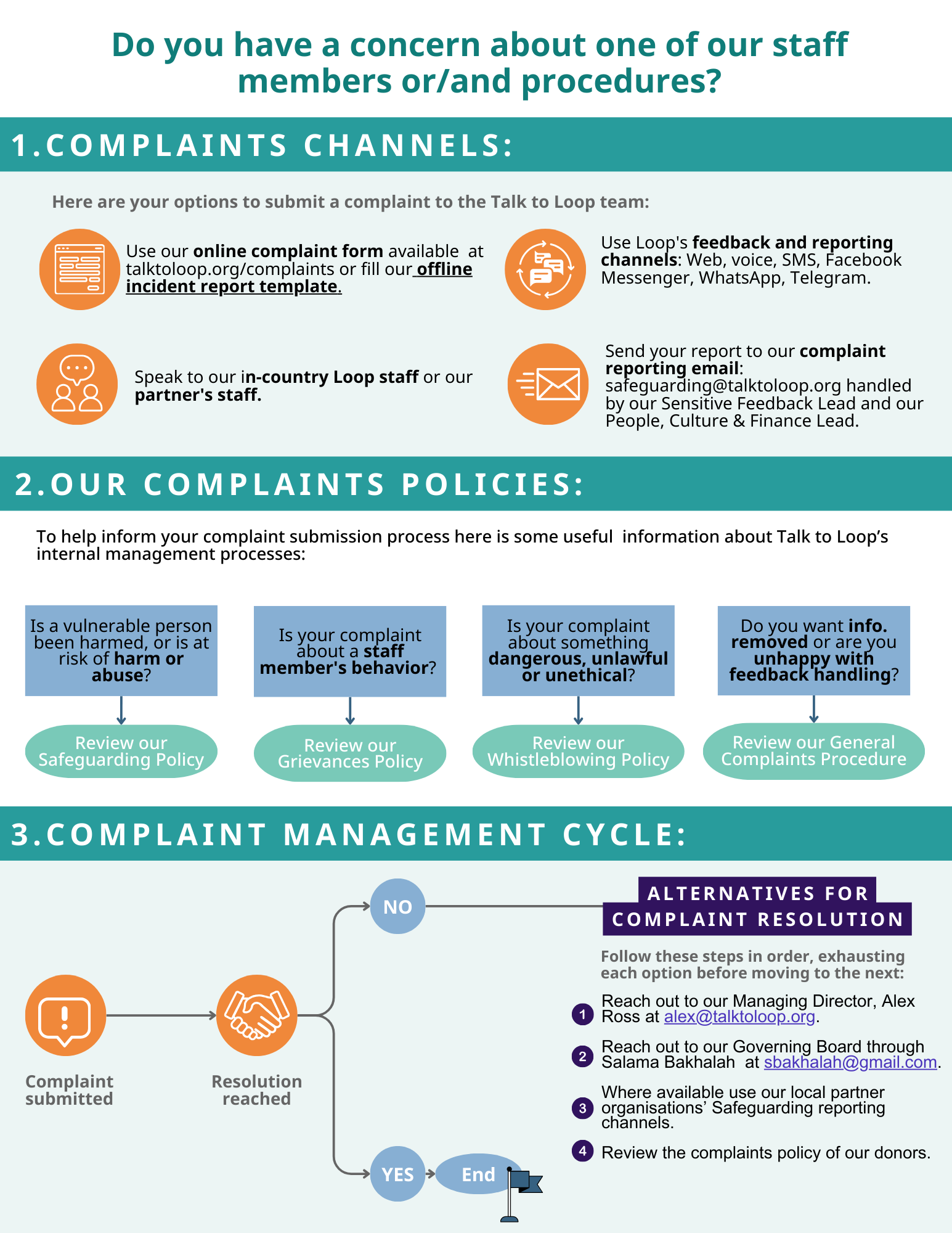
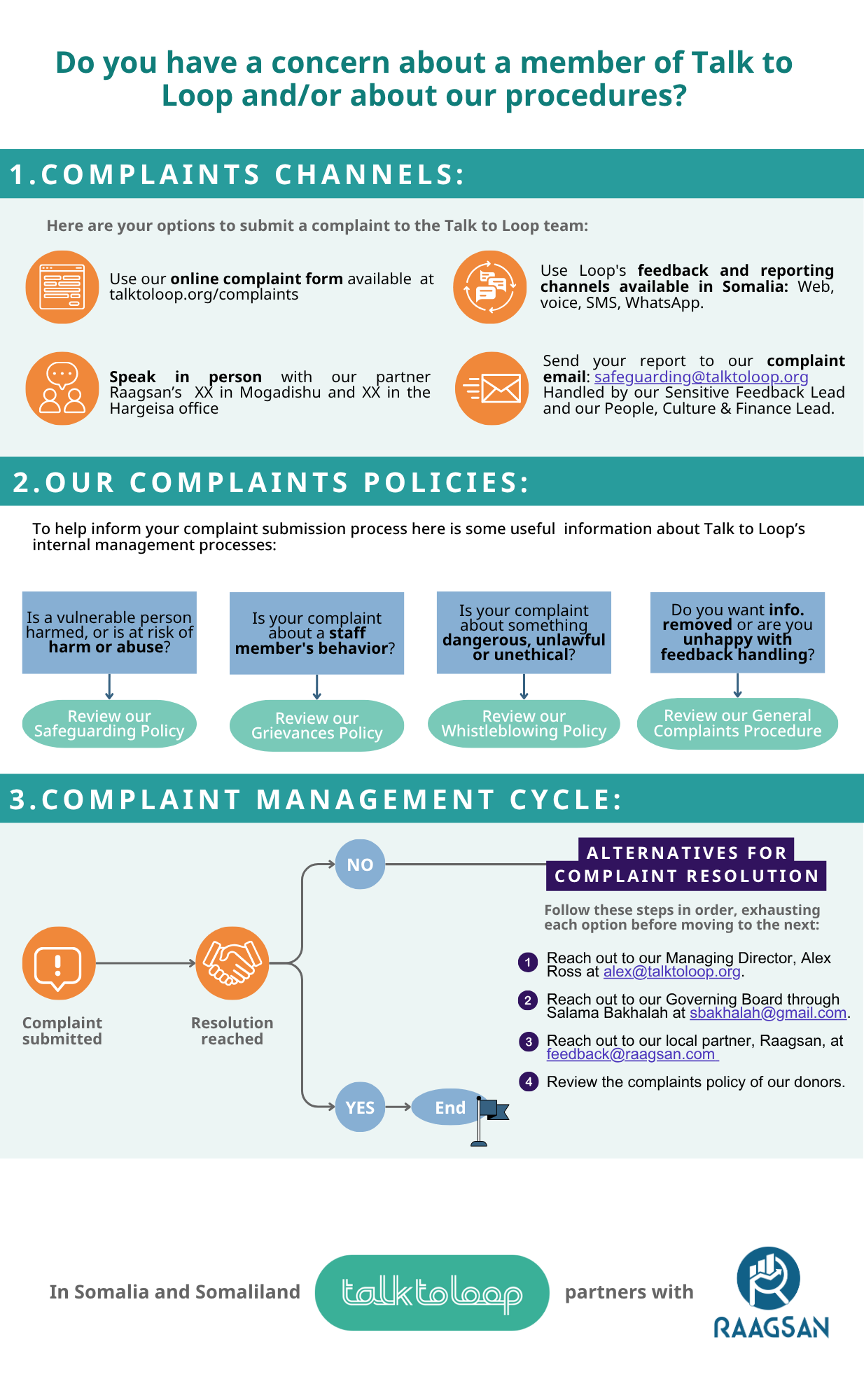
We are committed to maintaining the highest standards of integrity in everything we do. However, like any organization, we may occasionally face situations where conduct is dangerous, unlawful, or breaches ethical or professional codes.
This policy outlines the steps to take if you have reason to believe that something dangerous, unlawful, or unethical is happening at Loop, which may affect you, your colleagues, or the organization’s reputation, and you have been unable to resolve it through the usual internal reporting channels with your manager.
When you report concerns of this nature, it is referred to as whistleblowing.
This policy also applies to the actions of third parties, such as suppliers, service providers, and clients, in addition to our staff. If you have concerns about a third party, please raise them with us before approaching anyone else.
All team members, contractors, consultants, interns, and agency workers are covered by this policy.
The types of concerns you may want to raise with us could include, among others:
We value and respect all reports made to us and appreciate those who raise concerns. Each of us plays an important role in ensuring that our organization and everyone associated with it acts professionally, lawfully, and appropriately.
There will be no reprisals for making a report, even if, after our investigation, we determine that there has been no breach of law, policy, or unethical conduct. However, for protection to apply, the disclosure must be made in good faith and, in the reasonable belief of the person making the report, demonstrate that one or more of the events listed above has occurred, is occurring, or is likely to occur, and that it is in the public interest to make the disclosure. Please note that if a false concern is raised in bad faith (e.g., for malicious reasons), disciplinary action may be taken.
Speak to the Managing Director if you are unsure whether something that you are concerned about is covered in this policy.
This policy is not part of your employment contract. Loop may amend this policy at any time.
There are 3 types of whistleblowing:
Where individuals choose to openly report or disclose information or explicitly state that they do not require their identity to be kept confidential, they are encouraged to raise their concerns transparently. We fully protect whistleblowers from retaliation. If a whistleblower reports mistreatment by others, whether due to the act of raising their concerns or any other reason—we will take appropriate disciplinary action against those responsible.
The consequences for such misconduct could include dismissal for gross misconduct. In addition, whistleblowers may have the option to pursue personal legal action against individuals involved in retaliation.
Where the name and identity of the individual who disclosed information is known by the recipient but will not be disclosed without the individual's consent, unless required by law.
In this case, we will do all that we can to ensure that you retain your anonymity as far as possible. If we need to disclose your identity to others as part of the investigation, we will always discuss this with you beforehand, including our reasons for wishing to identify you.
Where a report or information is received, but no one knows the source.
We actively discourage anonymous whistleblowing. This is because it is not always easy to manage and to investigate anonymous reports; if we are unable to ask you for clarification for further details, we may struggle to clarify and find evidence to support your allegations and/or reach an informed conclusion. Either way we will do all we can to address the raised issues seriously with the information we have available to us.
The whistleblowing procedure we have put in place has been carefully designed to ensure that concerns are resolved effectively and that the complainant is protected throughout the process. For these reasons, we believe it would be extremely rare, if ever, that you would need to involve anyone outside of Loop. However, we understand that in exceptional circumstances, you may wish to involve an external body, such as an industry regulator, and we fully support those actions.
Involving the press/media
Involving the media in a whistleblowing matter often has the effect of inflaming the situation, not assisting it. It can significantly hamper evidence gathering and the willingness of other relevant individuals to support the process.
We therefore strongly discourage you from involving the media. We may treat any contact with the press as a serious disciplinary issue justifying dismissal unless you have taken all reasonable steps to deal with the matter internally following this procedure and still have serious concerns.
These are the steps you should take if you have reason to believe that something dangerous, unlawful or unethical is going on at Loop and it is affecting (or risks affecting) you, colleagues or our organisational reputation and you are unable to resolve it by discussing it with your manager.
You may do so in writing or in person.
If you would prefer not to discuss your concerns with the Managing Director, or you consider that your concerns are extremely serious, you should write to Salama from the Loop Governing Board at sbakhalah@gmail.com
Explain that you are raising your concerns as part of the Loop whistleblowing policy and procedure. Then set out all the key facts, including names of those involved and all relevant dates.
You are entitled to bring someone with you to this meeting and any subsequent meetings. That companion may be a colleague (or a trade union representative, if relevant).
Anyone accompanying you to the meeting will be required to agree to maintain strict confidentiality regarding the contents of the meeting, including any materials disclosed or examined during the session. This confidentiality obligation will extend before, during, and after the meeting, as well as throughout any subsequent investigation related to the concerns you’ve raised. This ensures that the investigation can proceed appropriately, without interference, bullying, or any other form of retaliation against the whistleblower.
While we strive to maintain openness and transparency in all matters, we prioritize the safety of our staff above all else and will take all necessary steps to protect them when their safety is at risk.
Using guidance from the CHS Alliance we may request that you come to additional meetings to assist in our enquiries. We may also decide to involve relevant external (or internal) specialists to help us conduct a thorough, fair and responsible investigation.
While we may not be able to share every detail of our findings or deliberations, we want to reassure you that we are taking your concerns seriously and are conducting a thorough investigation. We will keep you informed of the progress and provide updates on when you can expect to hear from us next. Due to various reasons, including legal obligations, confidentiality, and the safety of others, we may not be able to disclose specific details of the investigation, such as witnesses interviewed, the full findings, or any disciplinary actions taken. However, you will be informed of whether your claims have been substantiated and the key outcomes of the investigation.
If the outcome of our investigations is not one that you find satisfactory, you have the right to escalate your concerns to the relevant Governing Board member, Salama Bakhalah (sbakhalah@gmail.com) and request a case review.
If your complaint was submitted to the Governing Board member mentioned above and you are not satisfied with the outcome, you can write to Geoffrey Katerega as the President of the Governing Board at kateregga1@gmail.com.
We will always do our best to conduct investigations into whistleblowing complaints in a timely, thorough and conscientious manner.
If you have a grievance or complaint to do with your work or the people you work with breaking one or more agreements from the Codes of Conduct, the Grievance Procedure outlines how to deal with the situation.
Remember: The Grievance Policy and Procedure does not apply to breaches of the Safeguarding Policy or the Safeguarding Standards outlined in the Code of Conduct. If your complaint falls within the scope of the Safeguarding Policy, please follow the procedures outlined in that policy. Remember, confidentiality and the safety of individuals and information are paramount. Be sure to consult the Policies and the decision tree above to ensure you make the appropriate decision.
In some cases, if you feel that you are being subjected to workplace harassment or bullying, you can attempt to resolve the matter informally; it may be possible and sufficient for you to explain clearly to the person(s) engaged in the unwanted activities that the behaviour is unwelcome, that it offends and/or makes you uncomfortable.
If the steps outlined above are unsuccessful or not suitable, you should formally raise the matter in confidence with your manager. Alternatively, if you feel unable to speak to your manager, you may escalate the issue to a more senior manager.
The manager will discuss the matter with you and agree on an appropriate course of action. You may bring a representative or work colleague to these meetings if you wish. The alleged party will also have the right to present their version of events and may be accompanied by a representative or colleague.
Be assured that you will not face any discrimination or retaliation for raising a complaint. Confidentiality will be upheld throughout the process, and any necessary disclosure of case details will only occur with mutual discussion and agreement.
If the matter is serious and/or you wish to raise it formally, you should set out the grievance in writing to your manager. Stick to the facts and avoid language that is insulting or abusive.
Where your grievance is against your manager and you are unable to approach him/her, you should talk to the Human Resource Department or the Managing Director.
If you require anonymity to be protected during the grievance process, this can be discussed with the person managing the formal grievance procedure.
Note: Most Loop staff hold contracts with host organizations in the countries where we operate, and these contracts may include specific stipulations regarding workplace conduct and reporting breaches. In cases where there are discrepancies between the requirements of these contracts and Loop’s policies, the highest standard or requirement will take precedence.
If your grievance relates to sexual harassment in the workplace and it is against one of your colleagues, it is not recommended that you talk to the harasser directly. It is advisable that you keep a log of the incidents and choose one of the following options:
If your complaint is against your manager:
If your complaint is against a host organisation staff member:
Once the claims are received by the Managing Director, she will assess the situation and in line with the Safeguarding Policy and survivor-centred approach, appoint (or bring in if necessary) a trained Specialist from the team to investigate the claims. In all cases, Loop applies a survivor-centred approach to any allegations relating to sexual harassment in the workplace.
If the claim is shared anonymously and the survivor’s identity is not mentioned, Loop will not be able to investigate the claims as it might not be safe to do so without the consent of the survivor. However, Loop will, for example, put in place monitoring systems, reiterate Policies and rollout training to encourage reporting.
Your manager, or the person you shared the grievance with, will call you to a meeting to discuss your grievance, usually within 5 working days. You have the right to be accompanied by a colleague or trade union representative at this meeting if you make a reasonable request.
After the meeting the individual managing the grievance will give you a decision in writing, normally within 24 hours.
If it is necessary to gather further information before making a decision the individual managing the grievance will inform you of this and the likely timescale involved.
If you are unhappy with the decision and you wish to appeal you should let the person managing the grievance know in writing.
You will be invited to an appeal meeting with a more senior manager, normally within five days. You have the right to be accompanied by a colleague or trade union representative at this meeting if you make a reasonable request.
After the meeting, the new person managing the grievance will give you a decision, normally within 24 hours. The manager’s decision from the appeal is final.
To assess the effectiveness of this procedure, statistics will be maintained regarding the complaints received.
This policy's effectiveness will be reviewed following any serious incidents, if a complaint is raised about the procedure, or on a bi-annual basis.
Complaints about our platform, service or interactions with external services can be sent to the Managing Director (gabriella@talktoloop.org). For example: if you would like to have something removed from the platform, if you are unhappy with how your feedback was managed on the platform etc.
This channel can be used by anyone who is external to the organisation, including but not limited to service users, i.e. people affected by crises, partner agencies, suppliers; and funders and has a complaint that does not fall within the Safeguarding or Codes of Conduct Policies.
Complaints from users and community members can also be directed to Loop’s platform if appropriate. Loop offers several digital channels (Facebook Messenger, SMS, Loop’s Global WhatsApp number +31 97010251015, IVRR in countries where it is available (Somalia short code is 2023), and a Web and Telegram channel) that can be used to submit complaints against Loop services.
Depending on the nature of the complaint, the managing director (gabriella@talktoloop.org), will decide the best course of action/resolution and will communicate it to the complainant.